How Far Can a 64 GB M2 Ultra Push Local LLMs?
I wanted a local coding agent with thinking, reliable tool calls, screenshot input, and enough context for a real repository. I tested one model at a time, from a dense 27B Qwen through Jun Kim’s oQ builds, a faster MoE, Qwen3.8 Flash Next, and finally a 284B DeepSeek model through DwarfStar. The DeepSeek model can allocate a million-token context here, although that does not make it pleasant to use.
The answer first
| Use | Model and mode | What I measured |
|---|---|---|
| Fast daily agent | Qwen3.6 35B-A3B oQ4e + MTP | 104.4 tok/s |
| Practical 64 GB Flash model | Qwen3.8 Flash Next Q2 + MTP | 48.14 tok/s short-prompt median; 30–34 tok/s through 128K; 224K failed on M2 with pinned 18ca8ec |
| Harder coding | Qwen3.8 27B oQ4e + FP16 MTP | 39.9 tok/s |
| Reproducible long-context work | Qwen3.8 27B oQ4e, MTP off | 29.6 tok/s |
| Higher-precision dense baseline | Qwen3.8 27B oQ6e, MTP off | 23.8 tok/s |
| Oversized research model | DeepSeek V4 Flash Q2 at 32K | 11–13 steady tok/s |
| DeepSeek at 262K | 16 GB expert cache | 5.75 steady tok/s |
My current split is simple: use the MoE for quick agent loops, escalate difficult work to Qwen3.8, and treat DeepSeek V4 as a long-context research project.
The machine
| Component | Specification |
|---|---|
| Computer | Mac Studio (Mac14,14) |
| Chip | Apple M2 Ultra |
| CPU | 24 cores: 16 performance, 8 efficiency |
| GPU | 60 cores |
| Unified memory | 64 GB |
| Memory bandwidth | 800 GB/s1 |
| Internal storage | Approximately 1 TB SSD |
| Metal working-set recommendation | 51.84 GiB, measured from MTLDevice |
| Operating system | macOS 26.2 |
| Main runtime | oMLX 0.6.4 |
Unified memory is why this works at all. CPU and GPU share the same pool, which is central to MLX’s design.2 It is also why every browser tab, VM, KV cache, and model weight competes for the same 64 GB.
How I tested
This is a practical, reproducible study of one machine, not a leaderboard. Each model saw the same core tests:
- cold and warm 512-token generation;
- long prompts with facts hidden near the beginning, middle, and end;
- a second request sharing most of the same prefix;
- structured tool calls;
- a screenshot-reading task;
- three small Python implementations executed against hidden assertions;
- thinking with a bounded reasoning budget;
- MTP off and on, where supported;
- process footprint and macOS Swap.
The code gates are smoke tests, not a quality benchmark. I record failures because they reveal behavior. Prompts, logs, and raw results are published for reproduction.3
First baseline: dense Qwen3.8
I started with mlx-community/Qwen3.8-27B-8bit.4 It generated around 21.5 tok/s, correctly read my terminal screenshot, produced valid tool calls, and retrieved all three hidden values from a 23K-token prompt.
The surprise was not generation. It was caching. The cold 23K prompt took 145 seconds; a follow-up that reused 20,480 cached tokens finished in 21 seconds, and a fully cached repeat reached its first token in 0.86 seconds. For an agent that resends the same tool definitions and conversation prefix, cache behavior matters more than a small decode improvement.
I then switched to oQ checkpoints for a consistent runtime and sensitivity-based quantization pipeline.5
q4, q6, and q8
The first clean comparison used Jundot’s Qwen3.8 27B oQ4e, oQ6e, and oQ8e checkpoints. All retained the vision tower and matching MTP weights.
| Result | oQ4e | oQ6e | oQ8e |
|---|---|---|---|
| Model size reported by oMLX | 16.60 GB | 23.19 GB | 29.34 GB |
| Warm decode, MTP off | 29.6 | 23.8 | 20.6 |
| Warm decode, MTP on | 32.3 | 22.8 | 31.3 |
| Peak footprint in the comparison | 25 GiB | 33 GiB | 39 GiB |
| Long retrieval | 3/3 | 3/3 | 3/3 |
| Tool call and screenshot | Pass | Pass | Pass |
| Executable code gates | 3/3 | 3/3 | 2/3 |
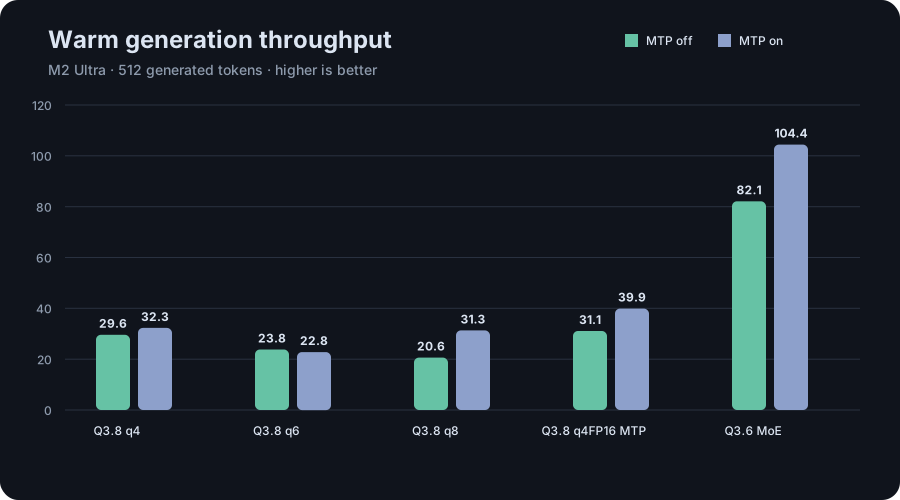
The q8 code miss was a type mismatch: it returned a tuple instead of a list of tuples. In a real q4 chat, 12,865 prompt tokens plus 6,819 generated tokens sustained 26.2 tok/s; a clean restart and 16,384-token answer sustained 26.9 tok/s for ten minutes. The 29.6 tok/s benchmark is real, but 26–27 tok/s better represents a long thinking session. That is plausible for a dense 16.6 GB model on 800 GB/s memory bandwidth after attention, KV, dequantization, and dispatch overhead.
The model that finally felt fast
Next I tried Jundot/Qwen3.6-35B-A3B-oQ4e-mtp. It stores roughly 35B parameters but activates about 3B for each token. All weights still occupy memory; the active parameter count controls how much work each token performs.
The difference was immediate:
| Qwen3.6 MoE test | Result |
|---|---|
| Warm decode, MTP off | 82.1 tok/s |
| Warm decode, MTP on | 104.4 tok/s |
| Thinking completion | ~97 tok/s |
| 15,359-token prompt | 14.8 seconds |
| Peak footprint | 26 GiB |
| Tool and screenshot tests | Pass |
| Executable code gates | 2/3 |
The thinking test produced 1,582 completion tokens. oMLX separated 4,061 characters of reasoning from a clean 2,468-character answer, and the server finished in 16.3 seconds after loading.
This is the first configuration that felt like an agent rather than a very knowledgeable person typing carefully. It is also an older model generation. One code answer contained unnecessary dead code, and another made an arguable interpretation of “touching” integer intervals. Speed makes iteration cheap; it does not remove the need to run tests.
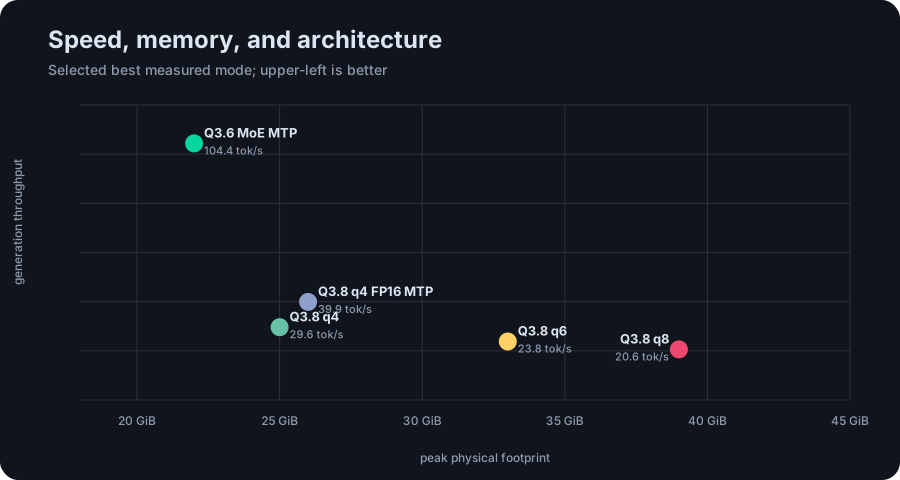
This pushed me toward a multi-model workflow: use different models for different jobs instead of pretending one model is best at everything.
A better MTP head for Qwen3.8
Jundot/Qwen3.8-27B-oQ4e-fp16-mtp sounds like a full FP16 model. It is not. The target remains oQ4e; the higher-precision MTP support adds less than 1 GiB.
That small change mattered:
| Qwen3.8 q4 variant | MTP off | MTP on |
|---|---|---|
| Normal MTP checkpoint | 29.6 tok/s | 32.3 tok/s |
| FP16 MTP checkpoint | 31.1 tok/s | 39.9 tok/s |
It passed all three executable code gates and produced a clean thinking answer at roughly 35 completion tok/s. Its speculative output was not byte-identical between runs, so I would disable MTP for reproducible evaluation and enable it for interactive work.
Qwen3.8 Flash Next on a 64 GB M2 Ultra
Ivan Fioravanti’s September 8 update made Qwen3.8 Flash Next worth testing on 64 GB.6 DwarfStar demand-pages the external PLE table when RAM is tight, while the Q2_K-down checkpoint reduces the main model to 44.81 GB. Earlier builds swapped heavily, so these are measurements from a physical 64 GB M2 Ultra.
I tested the pinned qwen3.8-flash-next branch at commit 18ca8ec, the current Q2 checkpoint, and its required 32 GB PLE sidecar. The model checksum matched the published SHA-256. I began from a zero-swap baseline and left my normal VM, Docker, browsers, editors, and desktop applications running. All performance runs used Metal, temperature 0, and a 1,024-token prefill chunk.
Full-context results
The ordinary-decode sweeps used the repository’s public-domain I Promessi Sposi text and generated 128 tokens at each frontier. Each context ran in a separate process so a failure or swap change could be attributed to that run.
| Context | Prefill | Generation | Steady generation | Planned memory | Result |
|---|---|---|---|---|---|
| 8K | 292.23 tok/s | 32.75 tok/s | 34.20 tok/s | 42.86 GiB | Passed |
| 32K | 347.98 tok/s | 33.31 tok/s | 33.42 tok/s | 43.69 GiB | Passed |
| 64K | 410.16 tok/s | 32.49 tok/s | 32.62 tok/s | 44.80 GiB | Passed |
| 128K | 345.01 tok/s | 30.03 tok/s | 30.14 tok/s | 47.00 GiB | Passed |
| 192K rerun | 269.49 tok/s | 25.73 tok/s | 26.24 tok/s | 49.21 GiB | Passed, after prior 128K run |
| 224K rerun | - | - | - | 50.32 GiB | Metal out of memory at token 2,048 |
| Near 262K | - | - | - | 51.42 GiB | Metal out of memory before prefill |
In the original sweep, Swap rose from zero to only 0.25 MiB on the first run and stayed there through 128K. I repeated the 128K control after restarting the Mac: it passed at 29.31 tok/s steady decode, but macOS Swap grew from zero to 721.94 MB by the end of the run. A subsequent 192K run passed at 26.24 tok/s, but began with that existing Swap and should not be treated as a clean memory-fit comparison. The 224K attempt planned 50.32 GiB and failed during prefill at token 2,048 with Metal out of memory. The 262K plan of 51.42 GiB also remains beyond this machine’s tested limit. These reruns reinforce that the result depends on the active system memory state, not just the nominal context allocation.
MTP, vision, and tools
For MTP I repeated the same deterministic 45-token prompt, allowing up to 256 generated tokens. Three runs with an 8K allocation reached 40.89, 48.14, and 48.14 tok/s, for a median of 48.14 tok/s. Two 32K-allocation runs reached 48.08 and 48.13 tok/s, and a 128K-allocation run reached 47.56 tok/s. Every run accepted 48 of 74 drafts, or 64.9%. These are short-prompt MTP measurements, not full-context decode rates, and Ivan’s comparison machine was an M3 Ultra rather than this M2 Ultra.
The optional 588 MB vision encoder also loaded successfully. On a synthetic 640x480 fixture, the model read “MAPLE 8153” correctly. The image used 300 tokens, and the short OCR turn generated at 51.33 tok/s with MTP, accepting 32 of 36 drafts. A deterministic no-thinking agent smoke test also made a valid bash tool call and wrote the expected value to a temporary file.
DwarfStar also exposes DS4_QWEN4_PLE_EVICT_TOKENS=1024 to discard clean PLE pages periodically during long sessions. In alternating 8K runs generating 1,024 tokens each, the warm decode median was 36.53 tok/s by default and 36.30 tok/s with eviction, while median warm prefill fell from 522.88 to 495.41 tok/s: about 0.6% of decode and 5.3% of prefill. Both modes kept Swap at 0.25 MiB, so I leave eviction off unless a long-lived session shows growing PLE residency.
So the updated Qwen3.8 Flash Next Q2 remains usable through 128K on this 64 GB M2 Ultra under the original controlled run, although the restart rerun shows that system memory pressure can materially change the Swap result. The 192K rerun completed but was not a clean memory-state test; 224K failed during prefill. I therefore keep 128K as the practical tested recommendation for this machine, not as a universal 64 GB limit. A later report reached 224K context on a different 64 GB machine, an M4 Max, reinforcing that this boundary is specific to my tested M2 Ultra configuration rather than a universal 64 GB limit.7
The public result archive includes the reproduction command, benchmark CSVs, artifact sizes, commit, checksum, context settings, throughput, MTP acceptance, the PLE eviction comparison, swap readings, and the failure boundary.8
A newer DwarfStar follow-up
After this M2 Ultra test, DwarfStar’s Qwen3.8 Flash Next support advanced beyond the pinned 18ca8ec commit. The current qwen3.8-flash-next branch is ccea768 or later. Ivan describes the Q2 result as surprisingly strong, while a separate 64 GB M4 Max report measured 224K end to end and used 160K as its practical daily window.9 That report also observed substantial memory pressure during real server use. These are encouraging follow-ups, but they do not change the M2-specific measurements above: on this machine and pinned build, 128K remains the practical recommendation, 192K completed only after prior Swap use, and 224K failed during prefill.
A 284B model from an 81 GiB file
Then I changed the question from “what is fast?” to “how far can this machine go?”
DwarfStar is a specialized DeepSeek V4 and GLM runtime by Salvatore Sanfilippo.10 Unlike ordinary MLX model loading, it keeps selected MoE experts in memory and streams the rest from SSD. The DeepSeek V4 Flash checkpoint I tested has 284B logical parameters, 13B active parameters, and a specialized 80.76 GiB Q2 layout.11 Sensitive tensors stay at Q8 or F16 while routed experts absorb most of the compression (DwarfStar model documentation).
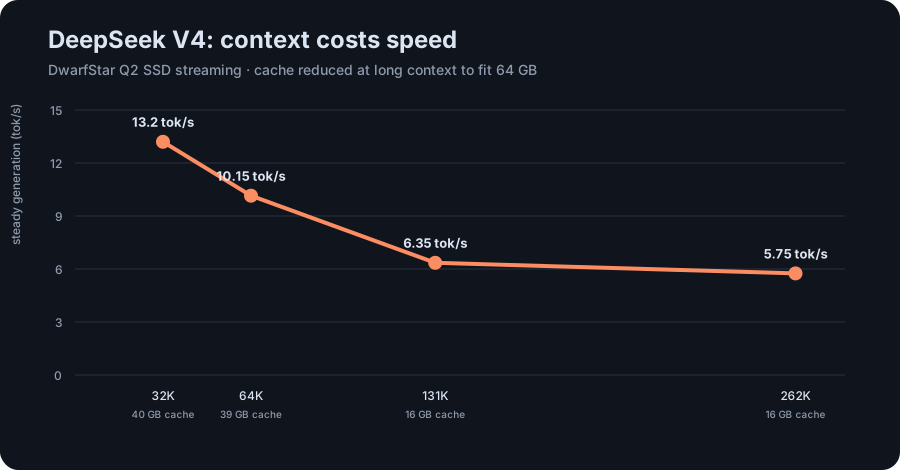
At 32K context, a 40 GB expert-cache target was the fastest isolated result:
| DwarfStar mode | Steady decode | Peak footprint | Practical result |
|---|---|---|---|
| 32K, 32 GB expert target | 11.25 tok/s | 36.3 GB | Safe with normal desktop workload |
| 32K, 40 GB expert target | 13.20 tok/s | 44.9 GB | Forced ~8.8 GiB Swap during real server use |
| 64K, 39 GB expert target | 10.15 tok/s | 43.7 GB | Works, but cold prefill takes minutes |
| 131K, 16 GB expert target | 6.35 tok/s | Lower cache budget | Capacity mode |
| 262K, 16 GB expert target | 5.75 tok/s | Lower cache budget | Capacity mode |
The isolated 40 GB result looked attractive until I ran the server alongside my normal VM, Docker, browser, and desktop applications. There the process settled at 41 GB and macOS still created nearly 9 GiB of Swap. The 32 GB cache added no Swap and became the honest recommendation.
One million tokens fits
A full 1,048,576-token allocation succeeded with a 16 GB expert-cache target.
| 1M allocation component | Planned memory |
|---|---|
| KV state | 8.39 GiB |
| Context buffers | 8.00 GiB |
| Resident model components | 2.81 GiB |
| Dynamic expert cache | 12.62 GiB |
| Prefill reserve | 3.38 GiB |
| Total | 35.20 GiB |
This is a good demonstration of compressed attention and explicit SSD streaming, and a bad interactive configuration. Measured prefill dropped from 174.6 tok/s at 131K to 106.9 tok/s for the next segment at 262K, and steady generation fell below 6 tok/s, so filling a million-token session would take hours. The only sensible use is to pay the prefill once, persist checkpoints, and reuse the same enormous prefix. For normal coding, Qwen at 128K is much faster.
The DwarfStar vision checkpoint did not survive the same experiment. Its image tokens reached a Metal range that the SSD-streaming model map had not covered, and prefill failed. Full residency is impossible on 64 GB, so Qwen remains my screenshot model.
What I would use today
| Situation | Choice |
|---|---|
| Fast daily thinking agent | Qwen3.6 35B-A3B oQ4e, MTP on, 128K |
| Difficult coding or review | Qwen3.8 27B oQ4e FP16-MTP, 128K |
| Reproducible automation | Qwen3.8 27B oQ4e, MTP off |
| Maximum tested Qwen context | Qwen3.8 27B oQ4e at 128K |
| Higher-precision dense work | Qwen3.8 27B oQ6e, 128K |
| Practical Flash model | Qwen3.8 Flash Next Q2 + PLE, up to 128K tested |
| Oversized model research | DeepSeek V4 Q2, 32K and 32 GB expert cache |
| Million-token experiment | DeepSeek V4 Q2, 16 GB expert cache, patience |
No single model won; architecture won different rounds. Dense Qwen3.8 gave the strongest recent-model behavior at 20–40 tok/s. The Qwen3.6 MoE crossed 100 tok/s and felt dramatically better for repeated agent steps. DwarfStar made an 81 GiB checkpoint and a million-token allocation possible on a 64 GB machine, but capacity and usability separated quickly.
The other lesson is that local inference is a whole-system test. A clean benchmark can report “no Swap” while the same configuration disrupts a real desktop, a model switch can briefly keep two sets of weights resident, and prefix caching can save more time than speculative decoding. The number worth keeping is not the highest token rate; it is the configuration I still want to use the next day.
Sources and reproducibility
All throughput and memory figures are measurements from this one machine. They are useful for choosing my configuration, not a universal model ranking.
Footnotes
-
Apple, Apple introduces M2 Ultra. ↩
-
Apple ML Research, MLX and Unified Memory. ↩
-
Raw prompts, logs, and result files for the original comparison:
b1tank/ds4,research/m2-ultra-runtime-comparison. ↩ -
Qwen Team, Qwen3.8-27B. ↩
-
Jun Kim, oMLX, oQ quantization, and Jundot model collection. ↩
-
Ivan Fioravanti, 64 GB demand-paging update, Qwen3.8 Flash Next Q2 weights, and DwarfStar test branch. ↩
-
Ivan Fioravanti, Qwen3.8 Flash Next reaching 224K context on a 64 GB M4 Max, tested by @pswai. ↩
-
Reproduction notes and raw results:
b1tank/ds4-metal,research/m2-ultra-qwen38-flash-next. ↩ -
Ivan Fioravanti, latest Q2 quality and DwarfStar update, and current
ccea768branch; @pswai’s 64 GB M4 Max daily-use report. ↩ -
Salvatore Sanfilippo, DwarfStar and its DeepSeek V4 synopsis. ↩
-
DeepSeek, DeepSeek V4 Flash. ↩